
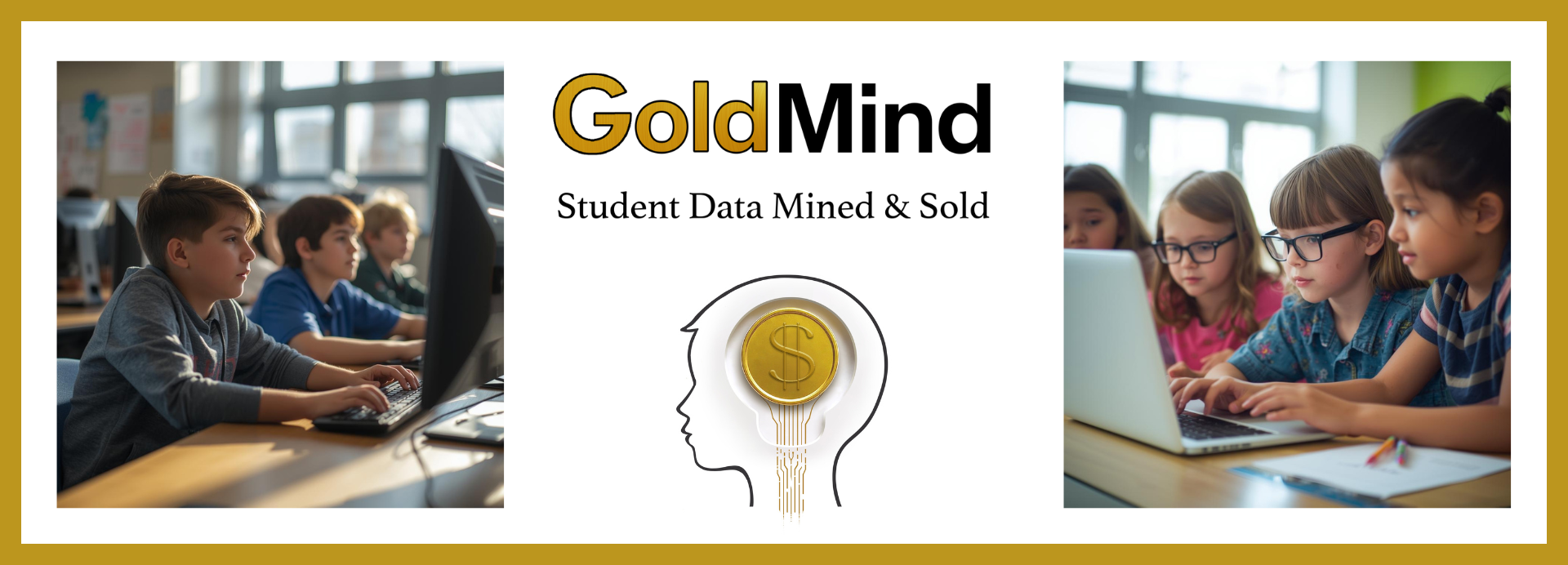

Data Mining Mindfulness
Mindfulness programs such as Inner Explorer can generate profits for Big Education corporations by potentially collecting and selling private student and family data.
SILENT SURVEILLANCE – Who is Watching Your Child?
AI student surveillance software has broad collection capabilities, and student data collected by AI student surveillance software is not kept private. These capabilities combined with the lack of data privacy can harm the very children the companies claim to protect.
WATCH THIS VIDE0:
GoldMind: Student Data Mining - An interview with
Peg Luksik. Education Advisor/Consultant
Hosted by Rhonda Thomas, President of Truthineducation.org
Porous Privacy Policies: How Mindfulness Meditation Apps Quietly Collect Student Data

The Liberty Sentinel | by Rhonda Thomas | January 8, 2026
Mindfulness meditation markets itself as the new one-size-fits-all solution to the many problems plaguing K-12 education, brought to schools courtesy of the Education Technology industry. By integrating mindfulness programs into the classroom, parents are led to believe that this technology will fix discipline, academics, and mental health. Yet these programs come with one quiet condition – that the apps can gather and share data on your child.
One example of a K-12 mindfulness program is the InnerExplorer app, which consists of “daily mindfulness programs [which] integrate seamlessly into classrooms,” providing 5-10 minute meditations that students conduct during class time. It is used in over 120 school districts in all 50 states, impacting over 2 million students and delivering over 2 billion “mindful minutes” to classrooms.
While mindfulness programs may seem like nothing more than an app with suggested classroom activities, parents must keep in mind that these programs collect and store student data in some capacity – even when the company contracts are carefully worded to seem otherwise.
For example, the InnerExplorer privacy policy states that they “do not collect or process information from students or children.” Yet the policy also states that “We permit educational personnel, including teachers and administrators, to register and input class-related information directly into our product through integrations…”One example of an integration such as this is CLEVER, a K-12 education rostering tool which states that its “secure integration with your SIS automatically shares student data with applications in real time.” The company also states that the “Inner Explorer SYNC app is integrated with CLEVER which allows for automatic account set up so teachers can simply launch the app and practice.”
While the InnerExplorer program may not collect data from students in accordance with its privacy policy, does this mean that it does not collect data about students that is integrated or synced from a school’s student rostering service – which includes a student’s entire data profile? When a student’s progress is saved in the mindfulness program app, does this data become synced with their student data profile?
The InnerExplorer privacy policy further notes that “[a]s part of providing our services, we may share data with third-party vendors who process information to assist us in delivering our services,” providing two examples of Amazon Web Services and Google Cloud. If the previous questions are answered in the affirmative, this would mean that student data is shared quite freely and broadly.
Parents must begin to question the data risks associated with their children using mindfulness programs in school, particularly in connection with their child’s K-12 school profile. Parents should request a copy of the program company’s privacy policies, any contracts signed with their child’s school or district, and a list of all third-party entities which have been provided with any of their child’s data, to include which data was provided. Better yet – parents should submit opt-out forms and notify the school that their child will not participate in mindfulness meditation programs or apps. In doing these things, parents will be taking the first steps to regain control of their child’s education data and privacy.
Please visit www.truthineducation.org to obtain an opt out form covering a variety of sensitive subjects along with instructions how to file it with your child’s school. Already have an opt out and need help enforcing it? Contact us at info@truthineducation.org.
Truth in Education (TIE), a Christian, Atlanta-based nonprofit that exposes harmful ideologies and Marxist globalist agendas in America’s schools and advocates for parental rights. TIE works to equip families and churches to reclaim their biblical role in children’s education. The organization leads efforts to promote homeschooling, launch Christian schools, and equip parents to stand firm in the spiritual battle for the hearts and minds of the next generation. Truth in Education also engages in legislative efforts to defend parental rights and protect children from government overreach.
FOR IMMEDIATE RELEASE
Georgia Nonprofit Launches GoldMind Campaign to Expose Student Data Collection and Mindfulness Practices in K–12 Schools
Truth In Education, a Georgia-based Christian nonprofit advocacy organization, has launched the GoldMind campaign to raise awareness about the growing use of digital education platforms and mindfulness meditation programs in K–12 schools, and the impact these tools have on student data privacy and parental rights.
As schools increasingly rely on educational apps and digital platforms, large volumes of student academic, behavioral, and personal data are being collected—often without clear parental knowledge or consent. According to Truth In Education, much of this data falls outside traditional federal privacy protections, such as the Family Educational Rights and Privacy Act (FERPA), and may be shared or sold within the education technology industry.
“Parents are often unaware of how much information is being collected about their children through school-issued devices and apps,” said Rhonda Thomas, president of Truth In Education. “GoldMind exists to educate families about these practices and to equip them with tools to ask better questions and protect their children.”
In addition to data privacy concerns, the GoldMind campaign highlights the use of mindfulness meditation programs in public schools. These programs, often presented as secular wellness tools, may introduce spiritual concepts related to meditation, consciousness, and worldview formation—raising concerns for families seeking transparency and alignment with their values.
The campaign launches amid rapid growth in the education technology sector, which reached an estimated $185 billion market in 2024, fueled in part by widespread adoption of digital learning tools and behavioral programs.
“Religious or spiritual concepts should never be introduced to children without parental knowledge,” Thomas said. “When those practices are paired with extensive data collection and monetization, it raises serious ethical and constitutional questions.”
Through GoldMind, Truth In Education aims to inform parents, policymakers, and community leaders about how student data is collected, stored, and used, while advocating for greater transparency, accountability, and parental consent in education.
For more information about the GoldMind campaign, visit https://truthineducation.org.
Media Contact:
Truth In Education
info@truthineducation.org
404-384-2583
©2026 All rights reserved. Short quotations may be used with proper attribution. This article may be shared in full, unaltered, with clear attribution to Truth In Education.
How To Stop School ‘Mindfulness’ Apps From Harvesting Your Child’s Health Data

The Federalist | by Katie Allen | January 13, 2025
Schools’ mindfulness meditation programs come with a hidden cost — the collection of children’s data, which could potentially be misused.
Mindfulness meditation programs have become an integrated part of K-12 public education, with companies marketing improved student achievement, discipline, and well-being. What parents don’t realize is that these programs come with a hidden cost — the collection of their child’s data.
The expansion of AI and student surveillance software in education has brought capabilities such as behavioral detection and monitoring of social media, student communications, and online activity. Generative AI data can be merged into a student’s education record along with their grades, transcripts, health records, financial information, and student discipline files. These digital profiles follow a child throughout their entire public education career, viewed and used by governments and corporations in combination with AI algorithms to influence student behavior, interventions, and even future opportunities. With so much data quietly being collected and accumulated on children, parents have begun to sound the alarm.
Three Programs
One example of a K-12 mindfulness program is the InnerExplorer app, which consists of “daily mindfulness programs [which] integrate seamlessly into classrooms.” It is used in more than 120 school districts in all 50 states, impacting more than 2 million students and delivering more than 2 billion “mindful minutes” to classrooms. It also provides lessons for individual teachers and even families.
Another program used in K-12 schools is MindUP, which “provides a curriculum at the intersection of neuroscience, positive psychology, mindful awareness, and SEL.” This curriculum offers individual classroom visits and assessments from the program consultants, and even a family training session as part of its outreach to “the extended school community.” Progress in mindfulness skills is measured using “an official MindUP pre- and post-evaluation toolkit to assess student outcomes, student/teacher satisfaction, and measure student/teacher social competencies.”
Perhaps the most advanced of the programs is MindLift, which “combine[s] Cognitive Behavioral Therapy, Self-Affirmation Theory, and AI technology” to provide personalized mental health interventions, noting that “[o]ur AI adapts to your unique needs and circumstances” to provide “inclusive support.” In the K-12 setting, the program provides “a student-specific AI-powered mental health assessment and intervention platform.” This platform provides an AI-driven chatbot that is used to assess student mental health by “create[ing] a real-time, multimodal system that can assess mental health through the use of behavioral pattern tracking, audio tone analysis, facial expression recognition, and text sentiment interpretation.”
While these are only three of the many mindfulness programs currently used in K-12 education, all mindfulness programs share the same marketing strategy: they come equipped with expert recommendations and numerous studies, making them seem like the answer to the growing mental health crisis facing many students today.
Blurring the Line Between Student and Health Records
For the InnerExplorer program, data collected and shared may be as simple as how often a student or family member completes the mindfulness video exercises. For the MindUP program, however, the data collected and synced to the student’s profile would include answers to their mental health survey questions, creating a record that arguably blurs the line between student records and health records. And while MindUP program data may blur the line, the data provided by the AI-driven chatbots and collection devices of the MindLift program would certainly cross it.
While K-12 education programs cite adherence to privacy policies and federal laws, parents must understand that these laws have had major exceptions carved out for education technology companies. For example, the Family Educational Rights and Privacy Act (FERPA) has been substantially weakened by allowing student data to be shared with third-party “school officials,” to include education companies and vendors performing contracted educational functions. Through creative wording, these companies are able to technically comply with their privacy policies and federal laws, even as most parents are left unaware that their child’s data is being collected and sold as part of the education company’s profit model.
It is time for parents to opt their child out of these mindfulness meditation programs at school and begin to reclaim their child’s data — and privacy.
Please visit www.truthineducation.org to obtain an opt-out form covering a variety of sensitive subjects along with instructions how to file it with your child’s school. Already have an opt-out and need help enforcing it? Contact us at info@truthineducation.org.
Katie Allen is policy advisor for Truth in Education, a Christian, Atlanta-based nonprofit organization that exposes harmful ideologies and Marxist globalist agendas in America’s schools and advocates for parental rights.
©2026 All rights reserved. Short quotations may be used with proper attribution. This article may be shared in full, unaltered, with clear attribution to Truth In Education.
Discovering Mindfulness Meditation Practices in Your Child’s School

Truth in Education | January 17, 2026
The digital transformation of education is a key driver of EdTech's profitability.
The “Big Education” industry (Big Ed) encompasses profitable components across different commercial, nonprofit, and government sectors. It is driven by technological innovation, implementation (EdTech), the political drive for globalism, and schools’ failure to improve outcomes. The digital transformation of education is a key driver of EdTech's profitability. The kindergarten through twelfth grade (K-12) segment is the largest and fastest-growing. The global education technology and smart classroom market currently stands conservatively at $214 billion and is expected to grow to at least $445 billion by 2029.
Despite the influx of Big Ed’s EdTech solutions, test scores have steadily declined in the United States for decades. Mindfulness markets itself as key to remedy this decline. Its promoters say it readies students to learn, self-regulate their emotions and imparts socialist values. In 1983 A Nation at Risk showed the US lagging behind other countries, The National Assessment of Educational Progress long-term trend data for 17-year-olds show scores in reading and mathematics had been essentially flat since the mid-1980s; then COVID with significant decline.
Is K-12 mindfulness programs just another profit-driven education technology product with no lasting results? It hasn’t brought overall sustainable learning measurements up.
Many EdTech companies and their third-party contractors collect and process vast amounts of student data, including login times, quiz responses, device usage, behavioral patterns, and demographic details like race, psychological assessments, and disability status. The underlying business models of many EdTech vendors rely on data-driven revenue streams rather than direct sales to schools.
Although companies may claim not to “sell” personal data in the traditional sense, they profit by building detailed user profiles based on behavioral tracking. These profiles are then used to offer targeted advertising, analytics services, or access to student audiences for commercial purposes.
Data deception isn’t the only mindfulness concern. It has ancient roots in Hinduism and Buddhism. Jon Kabat-Zinn, a student of Buddhist monk Thich Nhat Hanh, created the Mindfulness-Based Stress Reduction (MBSR) program in 1979. MBSR is the cornerstone of its mindfulness application. Hinduism and its yoga relative predate Buddhism by over a millennium. Buddhism developed in direct dialogue with Hindu ideas, particularly karma, samsara (cycle of rebirth), and dharma.
Christian parents and those of other religions should question why mindfulness meditation – a Hindu/Buddhist/New Age form of prayer and worship – is daily practiced and taught to their children during class time as part of taxpayer funded public school curriculum. If in a private school, was mindfulness fully explained prior to enrollment?
Parents must question the risks associated with their children using mindfulness programs in school, regardless of its widespread presence. Children facing stress, anxiety, and other possible mental health concerns should be directed to their parents for help – not taught that it is something classroom breathing meditation exercises or a personalized AI-driven chatbot mining their mental health data can solve.
At the very least, parents should question what mindfulness programs their child is using at school and if it is connected to their child’s school data profile. Parents should request a copy of the mindfulness company’s privacy policies and any contracts signed with their child’s school or district. Parents should also request a list of all third-party companies or vendors which have been provided with any of their child’s data, and what data was provided, as “most sell collected data even when they say they don’t.”
Finally, parents should submit opt-out forms and notify the school their child will not participate in mindfulness meditation programs. In doing these things, parents will be taking the first steps to regain control of their child’s data and protect their children from becoming profit points for Big Education companies.
QUESTIONS TO ASK SCHOOLS
How can I opt my child out of mindfulness meditation programs?
Where is the policy published regarding mindfulness meditation programs?
Where can I obtain information about a privacy release for my child’s data?
QUESTIONS TO ASK CHILD/REN
Instead of direct questions, parents can use open-ended prompts that invite reflection and conversation. These questions help uncover whether a child’s mindfulness practice includes elements from New Age related religious traditions:
Do you have a time at school where you practice mindfulness? If so, what do you do during that time? (This invites the child to describe activities, which may reveal techniques like breath focus, chanting, loving-kindness meditation, or others)
“Do you talk about your feelings, thoughts, or about your family? (Concepts like fluid identity or detachment from outcomes may be found)
Have you learned any special words or phrases to say in your mind when you’re calm? (This can gently uncover the use of mantras or phrases rooted in spiritual religious traditions)
In opening up dialogue with their children and schools, parents can take a powerful step forward in both discovering and preventing their child being taught mindfulness meditation practices.
Please visit Truth In Education to obtain an opt out form covering a variety of sensitive subjects, along with instructions on how to file it with your child’s school. Already have an opt out and need help enforcing it? Contact us at info@truthineducation.org.
Barbara Bush is a Research Analyst for Truth in Education, a Christian, Atlanta-based nonprofit organization that exposes harmful ideologies and Marxist globalist agendas in America’s schools and advocates for parental rights.
©2026 All rights reserved. Short quotations may be used with proper attribution. This article may be shared in full, unaltered, with clear attribution to Truth In Education.
THE DATA PROFILE – Your Child’s First Social Credit Score

White Paper
The data collection framework in schools is preparing students to become the pioneer generation of a social credit score system – without them ever realizing it.
The Data Collection Framework of Public Education
Under the guise of student safety, surveillance programs collect a wide range of data to include AI-driven behavioral detection, social media monitoring, student communications monitoring, online and web monitoring, and remote video monitoring/proctoring. 1 These programs are software installed on student devices and attached to student school logins, using a search algorithm to constantly scan all student activities to identify material that is problematic and subsequently alert designated school or law enforcement personnel. Activities monitored can include social media posts, chats, documents, comments, emails, and more. While seemingly limited to school devices, this surveillance software can also function on a student’s private devices at home if a student uses their school-issued login for a program or social media account. 2 Types of collected data can include student and parent/guardian first and last names, physical address and email address, along with parent/guardian phone numbers, student ID, and a student’s location during use. 3 In perhaps the most alarming example of modern student surveillance, the CLEAR software product by Thomson Reuters allows designated school district personnel to “[a]ccess license plate data and develop pattern of life information” on students and families:4
1 Digital Dystopia: The Danger in Buying What the EdTech Surveillance Industry is Selling, AMERICAN CIVIL
LIBERTIES UNION 9,10 (2023), https://assets.aclu.org/live/uploads/publications/digital_dystopia_report_aclu.pdf.
2 Frequently Asked Questions, GAGGLE (2025), https://www.gaggle.net/frequently-asked-questions.
3 Student and Staff Data Privacy Notice, GAGGLE (2025), https://www.gaggle.net/student-data-privacy-notice.
4 CLEAR for Residency Verification, THOMSON REUTERS (2025),
https://legal.thomsonreuters.com/en/c/clear/thomson-reuters-clear-for-residency-verification.
©2026 All rights reserved. Short quotations may be used with proper attribution. This article may be shared in full, unaltered, with clear attribution to Truth In Education.
Schools Are Mining Your Children’s Minds: My Interview with Rhonda Thomas
The disturbing truth about mindfulness programs, student data surveillance, and what every Christian parent needs to know
By: John Rushemeza | May 26, 2026

THE DATA PROFILE – Your Child’s First Social Credit Score
The data collection framework in schools is preparing students to become the pioneer generation of a social credit score system – without them ever realizing it.
Truth in Education | March 2026
The Data Collection Framework of Public Education
Under the guise of student safety, surveillance programs collect a wide range of data to include AI-driven behavioral detection, social media monitoring, student communications monitoring, online and web monitoring, and remote video monitoring/proctoring. 1 These programs are software installed on student devices and attached to student school logins, using a search algorithm to constantly scan all student activities to identify material that is problematic and subsequently alert designated school or law enforcement personnel. Activities monitored can include social media posts, chats, documents, comments, emails, and more. While seemingly limited to school devices, this surveillance software can also function on a student’s private devices at home if a student uses their school-issued login for a program or social media account.2 Types of collected data can include student and parent/guardian first and last names, physical address and email address, along with parent/guardian phone numbers, student ID, and a student’s location during use.3